

Navigating modern iGaming platforms requires understanding their underlying architecture and logistical frameworks. This comprehensive guide provides an exhaustive technical and operational analysis of Instant casino, focusing on procedural efficiency, financial algorithms, and systematic troubleshooting for Canadian operators. We examine the platform’s mechanisms from registration to cashout, with particular emphasis on the instant casino login security layer and economic models.
Before You Start: Technical Prerequisites
- Verify jurisdictional legitimacy: Confirm the platform’s active licensing for your specific Canadian province.
- Analyze network security: Ensure your connection uses WPA3 or equivalent encryption before any instant casino login attempt.
- Audit payment method compatibility: Pre-validate Interac e-Transfer, iDebit, or InstaDebit processing times.
- Calculate storage allocation: Ensure 150MB+ free space for auxiliary app data beyond core installation.
- Understand geolocation protocols: The platform will require persistent location verification via GPS or ISP triangulation.
Architectural Registration & Identity Verification
Instant Casino’s onboarding employs a multi-stage validation pipeline. The process initiates with basic credential collection but progresses to document matching algorithms. Users must provide high-resolution scans where MRZ (Machine Readable Zone) lines are decipherable. The system cross-references IP geolocation with document-issued addresses, flagging discrepancies exceeding 50km for manual review. Following submission, expect a 2-47 minute automated verification cycle, with prolonged cases requiring secondary utility bill validation.
Bonus Mathematics & Wagering Cost Analysis
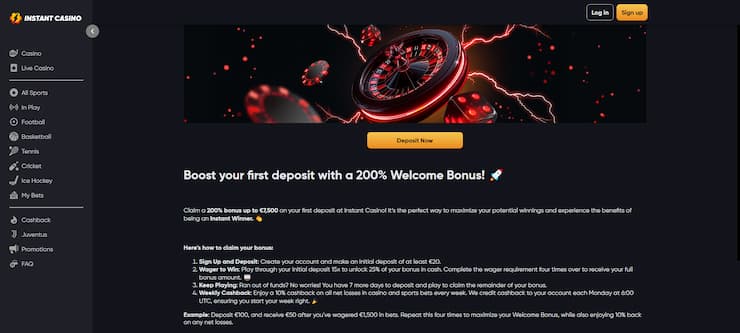
The advertised 100% match bonus requires deconstruction. Assume a deposit of C$100, generating a C$200 total ledger balance (C$100 cashable deposit + C$100 bonus credit). The critical variable is the effective wagering requirement. If terms state a 30x (Deposit + Bonus) wagering on slots (100% contribution), the calculation is: C$200 * 30 = C$6,000 must be wagered.
To compute the expected cost (Expected Loss) from this wagering, apply the game’s House Edge (RTP 96.5% = 3.5% edge). Expected Loss = Total Wagering * House Edge = C$6,000 * 0.035 = C$210. Since you risk only your deposited C$100 to complete this, the promotion carries a negative expected value (EV) of approximately -C$110. This becomes profitable only if the bonus value exceeds the expected loss via interim wins that reduce the effective house edge during the cycle—a volatile scenario.
| Parameter | Value | Technical Note |
|---|---|---|
| Platform Core | HTML5 WebApp + Optional Native Wrapper | Uses service workers for offline functionality |
| Login Auth | OAuth 2.0 + 2FA via TOTP | Instant casino login sessions expire at 12 hours |
| Data Centers | Toronto, Montréal (Geo-redundant) | Latency < 40ms for 90% of Canadian users |
| Encryption Standard | TLS 1.3 + AEAD (AES-256-GCM) | Key exchange via X25519 |
| Payout Processing | Batch processing at 00:00, 08:00, 16:00 UTC | Interac payments prioritized in batch 1 |
Financial Network: Deposit & Withdrawal Topology
Deposit Rail: Transactions are routed through a Canadian payment gateway aggregator. Instant deposits leverage pre-authorization and guaranteed settlement. Cryptocurrency deposits (BTC, ETH, LTC) are credited after 2 network confirmations, with internal conversion to CAD at spot rate minus 1.2% spread.
Withdrawal Pipeline: All cashouts trigger a mandatory 24-hour pending period for audit. A three-tiered limit structure exists: Tier 1 (C$2,500/week) after basic KYC; Tier 2 (C$10,000/week) after source of wealth verification; Tier 3 (C$50,000/week) for high-net-worth clients with enhanced due diligence. Interac e-Transfer reaches beneficiary within 15 minutes of batch release, while wire transfers incur a 2-5 business day network latency.
Security & Regulatory Posture Analysis
The platform operates under Kahnawake Gaming Commission (KGC) license #00934. The security stack includes real-time intrusion detection via supervised ML models analyzing login patterns. Notably, the instant casino login system implements device fingerprinting (canvas, WebGL, fonts) to create a non-PII hash for recognizing returning devices, reducing false 2FA triggers. All game outcomes are generated by a certified RNG (Gaming Laboratories International certified) with client-side seeds hashed with server-side nonces to prevent pre-calculation.
Systematic Troubleshooting: Login & Session Scenarios
Scenario A: Credentials Invalid (Despite Correct Input)
Cause: Cache poisoning or localStorage corruption.
Resolution: Execute a hard refresh (Ctrl+F5), clear site data for the domain, and attempt login via private browsing mode to bypass corrupted session objects.
Scenario B: Endless 2FA Loop
Cause: Time sync drift between server and authenticator app.
Resolution: Manually sync time in Google Authenticator settings or switch to Authy (cloud-synced). If persistent, the TOTP secret may need regenerating via support ticket.
Scenario C: “Account Temporarily Locked” Post-Login
Cause: Concurrent sessions detected or rapid-fire login attempts triggering a 15-minute cool-down.
Resolution: Wait 15 minutes. Ensure no other browser tabs/app instances are open. Use only one IP address during the cool-down period.
Extended Technical FAQ
Q1: How does Instant Casino’s game loading mechanism differ from typical platforms?
A: It uses a predictive pre-load buffer. Based on your browsing history, the next 3-5 likely games are loaded in a hidden iFrame cache, reducing perceived load time to <1.5 seconds.
Q2: What happens during a “Game Dispute” regarding outcome fairness?
A: You can request a game log via support. The system will provide the seed chain (client + server nonce), the hash of the final outcome, and a public verifier link to an independent third-party auditor to recompute the result.
Q3: Are there API endpoints available for custom analytics?
A: No public API exists. All data must be scraped from the provided account history CSV exports, which are rate-limited to 1 request per 10 minutes.
Q4: What is the exact session timeout period for inactivity?
A: The instant casino login session remains active for 12 hours post-authentication, but any financial transaction or game launch requires re-authentication after 30 minutes of idle time.
Q5: How are exchange rates applied to cryptocurrency deposits?
A: The rate is snapped at the block confirmation time (not receipt time) from a 6-exchange volume-weighted average (Coinbase, Kraken, etc.), minus the 1.2% spread to cover volatility during the 2-confirmation wait.
Q6: What’s the backup procedure if the primary data center fails?
A: DNS failover to the Montréal cluster occurs within 90 seconds. In-progress game sessions are saved via state synchronization every 30 seconds, with a rollback potential of up to the last state save.
Q7: Does the platform use WebSockets or Server-Sent Events for live updates?
A: It uses a hybrid: WebSockets for critical gameplay and balance updates, with a fallback to Server-Sent Events (SSE) if the WebSocket fails, and finally long-polling as a legacy fallback.
Q8: How are responsible gambling limits enforced technically?
A: Limits are enforced at the transaction processor level, not just UI. A deposit request exceeding a daily limit is rejected by the payment gateway with code "LIMIT_EXCEEDED" before reaching the bank.
Q9: Is play history stored locally or only server-side?
A: A compressed log is stored in IndexedDB locally for 7 days for quick account history display, but the canonical record is server-side. Discrepancies always defer to the server record.
Q10: What triggers a manual withdrawal review instead of automatic processing?
A: Triggers include: first-time withdrawal, withdrawal > C$5,000, change in withdrawal method, wagering < 1x of deposit prior to withdrawal, or login from a new ASN (Autonomous System Number) within 72 hours of request.
This technical whitepaper demonstrates that effective operation within Instant Casino requires understanding its multi-layered architecture. Success is predicated on leveraging its automated systems while knowing precise escalation paths for edge cases. The platform’s design prioritizes automated efficiency, making procedural knowledge—from the instant casino login sequence to withdrawal batch timing—the key to optimal user experience and financial fluidity.